The Sound of Silence: How Medieval Monk Chants Help Us Unwind Today

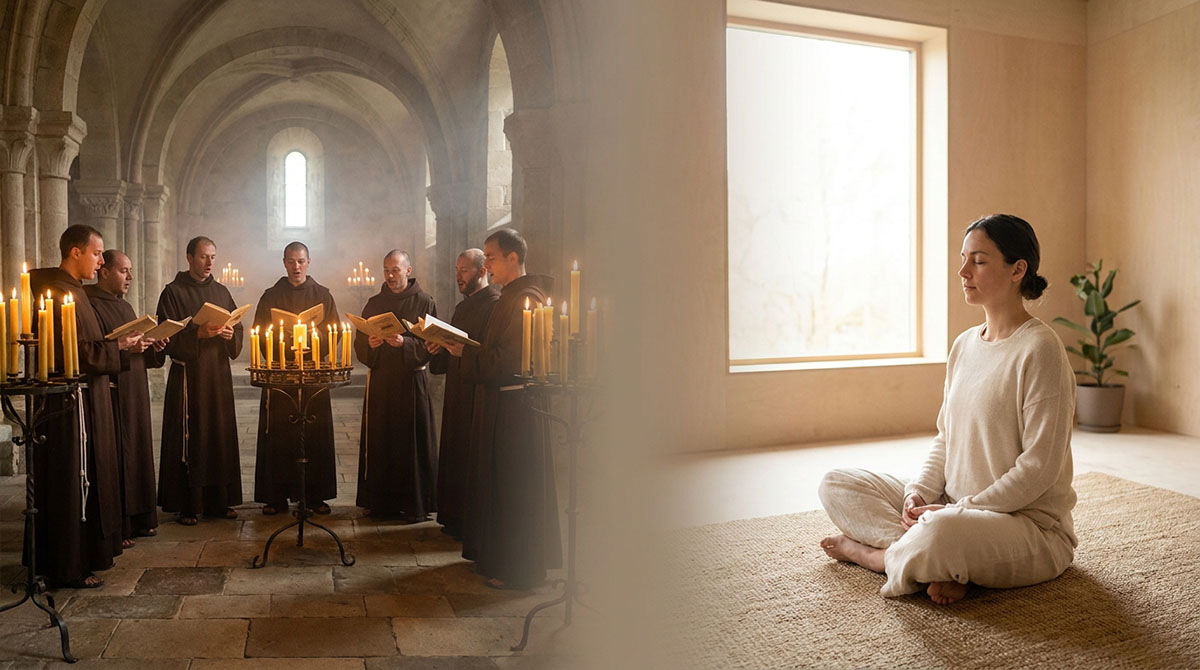 Imagem gerada por IA
Picture it: the high, cool stone walls of a medieval abbey. Candlelight throwing long shadows across the floor while a deep, resonant chant fills the room. The monks' voices seem to melt into one another, leaving behind something close to tangible stillness.
It's not a coincidence that just picturing this makes you want to take a slow breath. People have understood the calming power of sound for almost a thousand years. Today, those centuries-old vibrations are having a real moment in modern wellness circles — under the name Solfeggio frequencies.
So what's actually behind the monks' famous sound, and how can we use it to unplug from an overstimulated day?
The origin: a monk's stroke of genius
Our story starts in 11th-century Italy. A Benedictine monk named Guido of Arezzo had a problem: his choir students needed years to memorize the church's increasingly complex chants. So Guido invented a way to write music down, using a well-known hymn — the Hymn to St. John the Baptist (Ut queant laxis) — to teach singers the distance between notes.
The first syllable of each line read: Ut, Re, Mi, Fa, Sol, La.
Those syllables might ring a bell. They're the direct ancestor of today's "Do-Re-Mi." Guido had just laid the foundation of Western music theory — mostly to save his students a headache.
The bridge to today: rediscovering the frequencies
Centuries later, in the 1970s, researcher Dr. Joseph Puleo went back to those old chants looking for something more. Convinced there was a mathematical pattern hidden in the syllables, he ran the six original tones of the hymn through a numerology system and assigned each one a specific frequency, measured in Hertz (vibrations per second):
- 396 Hz (Ut) — used today to release circling thoughts and gently dissolve inner blocks
- 417 Hz (Re) — said to support opening up to change and letting new energy in
- 528 Hz (Mi) — the famous "transformation frequency," a go-to in wellness circles for deep meditation and inner harmony
- 639 Hz (Fa) — associated with heart-centered meditation, compassion, and harmonious relationships
- 741 Hz (Sol) — linked to mental clarity and "clearing the clutter"
- 852 Hz (La) — tied to intuition and a stronger sense of direction
Here's the honest part: medieval monks had no concept of "Hertz" — there were no instruments to measure sound that way in the 11th century. The frequency values above come from Puleo's 20th-century numerology, not from anything measured in a medieval choir loft. If you want the fuller, more skeptical take on where these numbers actually come from and what the research does and doesn't support, our guide on understanding Solfeggio frequencies walks through it in more detail.
Vibration over stress: how the frequencies affect us
So why does this sound feel so good? Your brain is remarkably good at matching its surroundings. When you listen to steady, harmonic tones, your brainwaves tend to sync up with them — a process researchers call entrainment.
Solfeggio frequencies work like a quiet signal to your nervous system: "You're safe. You're allowed to relax." They can help pull you out of a stressed-out beta state and into the slower alpha or theta waves — the same territory your brain visits when you fall asleep or drop into deep meditation.
Tips for your own sound break
You don't need a monastery to feel these vibrations at work. Here's how to fold Solfeggio frequencies into an ordinary day:
- As background for yoga or journaling. Let a 528 Hz or 639 Hz playlist run quietly while you stretch or write.
- Before bed. Something like 396 Hz is genuinely good at slowing down a racing mind before lights out.
- Active listening. Set aside 10 minutes, close your eyes, put on headphones, and focus on nothing but the sound. Breathe slowly, all the way into your stomach.
Give it a shot and see for yourself how a thousand-year-old sound can take some of the edge off a modern day. If you'd rather just hit play, the AuraHarmony demo on our homepage runs right in your browser — no download required.