Smartphone Frequencies on the Oscilloscope

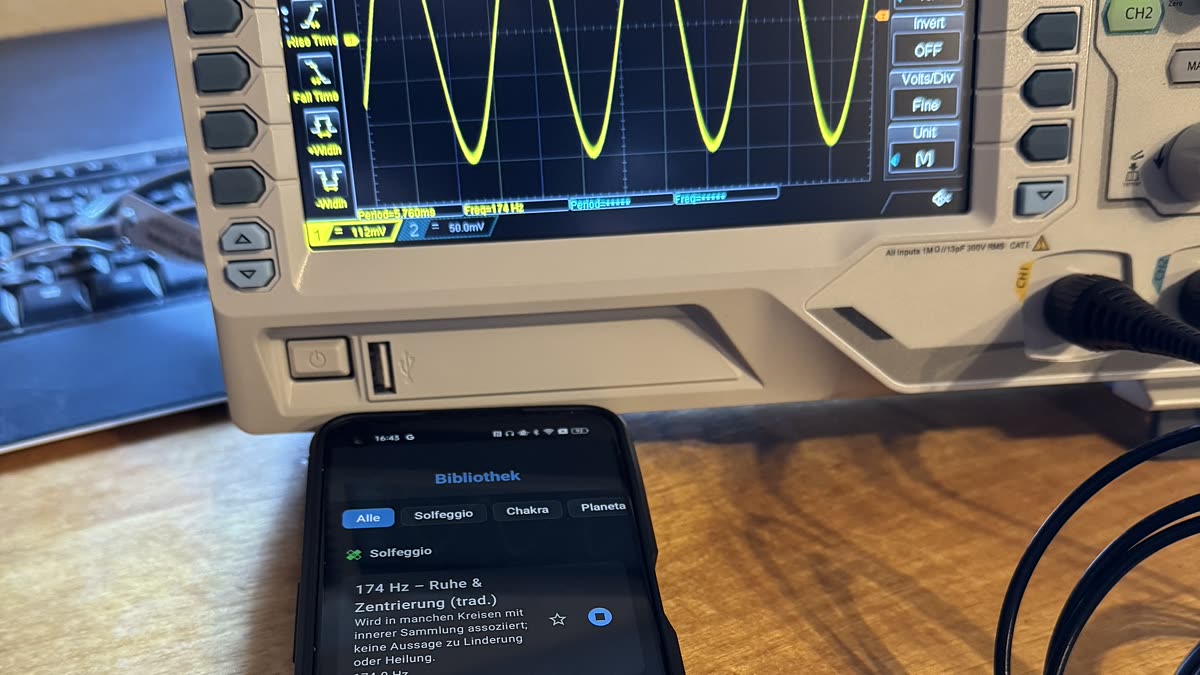
Some claims about smartphone frequency apps just stick in your head. One of them: that smartphones can't reproduce clean sine waves — only a "real" hardware frequency device supposedly can. The claim makes more sense once you notice who tends to make it: the same companies that sell those devices for several hundred euros.
Rather than argue, I measured.
The setup
This wasn't meant to be a scientific publication. It was meant to answer a simple, verifiable question: does the signal coming out of an ordinary smartphone's headphone jack actually match what the app says it's producing?
- Smartphone: OPPO Android, consumer-grade, not specifically chosen for pro audio
- App: AuraHarmony, current version
- Oscilloscope: Rigol DS1102 Z-E (2 channels, 100 MHz bandwidth, 1 GSa/s sample rate)
- Probe: 10× passive probe, DC coupling, bandwidth limit off — no filtering that could clean the signal artificially
- Connection: headphone jack via adapter, straight to the probe
No special preparation on the phone. No hidden settings. Volume at normal listening level. Any hobbyist could replicate this in an afternoon.
Test 1: A single Solfeggio frequency (174 Hz)
The simplest test first: pick one frequency, look at what arrives at the output.
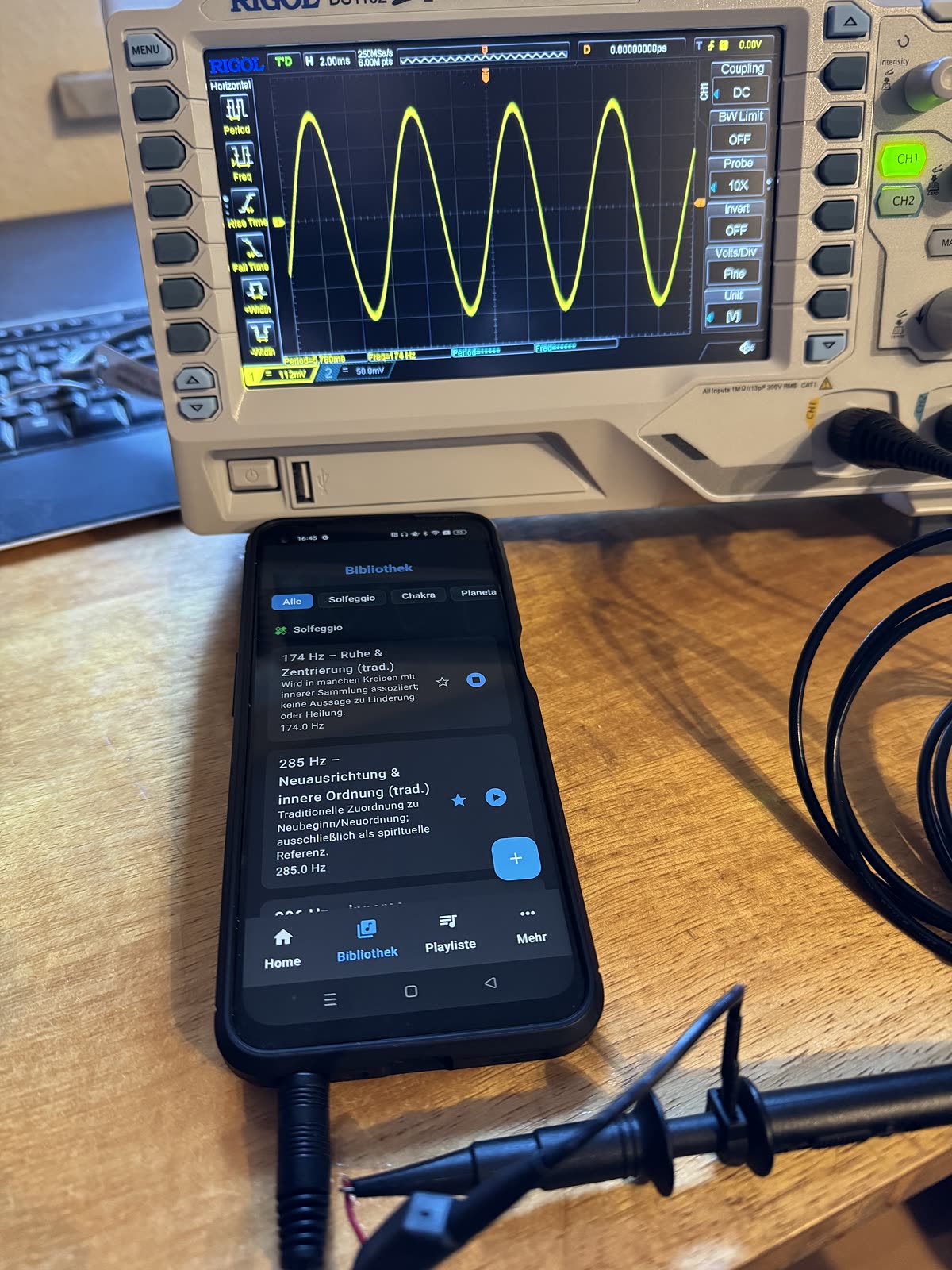
The scope display reads it back to us in the bottom row: Period 5.760 ms, Frequency 174 Hz. That's exactly the value the app shows. The waveform itself is a calm, regular sine — no visible harmonics, no distortion, no kinks at the peaks. Four complete cycles on screen, all matching.
Measured amplitude is 112 mV — typical headphone-output level at moderate volume.
Test 2: Several frequencies in sequence
Reproducing one frequency correctly is one thing. Switching between frequencies is where a careless implementation can introduce clicks, phase jumps, or brief silences. In the test video I stepped through several Solfeggio frequencies in turn:
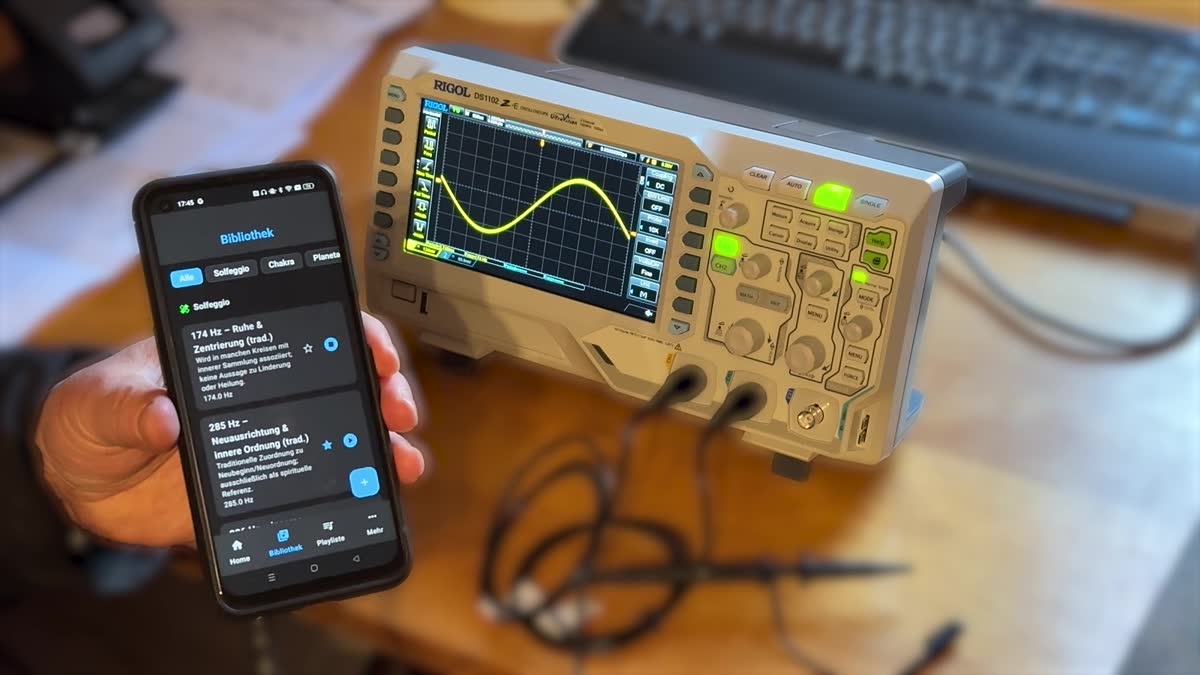
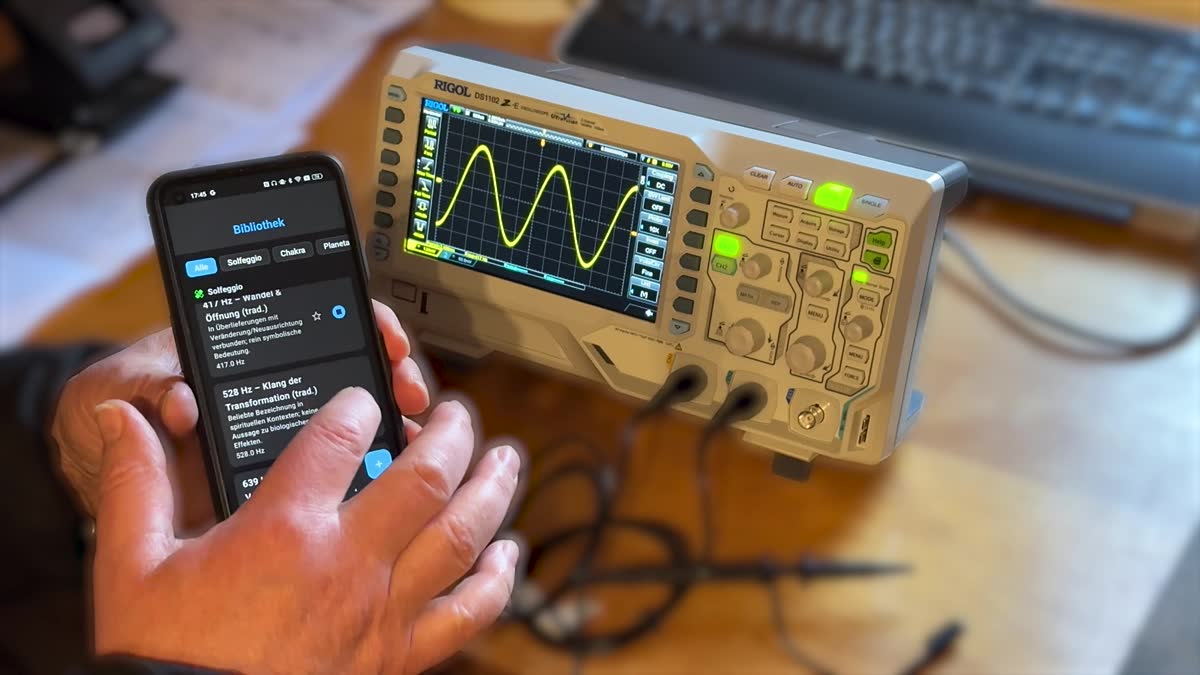
Higher frequencies pack more cycles into the same screen width — that's it. The waveform stays a clean sine. Transitions between frequencies are seamless: no audible clicks, no visible discontinuities.
Test 3: Binaural mode — the harder discipline
Binaural beats are where things get technically interesting. The left channel plays one frequency, the right plays a slightly different one — the brain perceives the difference as a beat. This only works if the smartphone genuinely outputs two separate, precisely defined frequencies. Stereo separation isn't a nice-to-have here; it's the whole point.
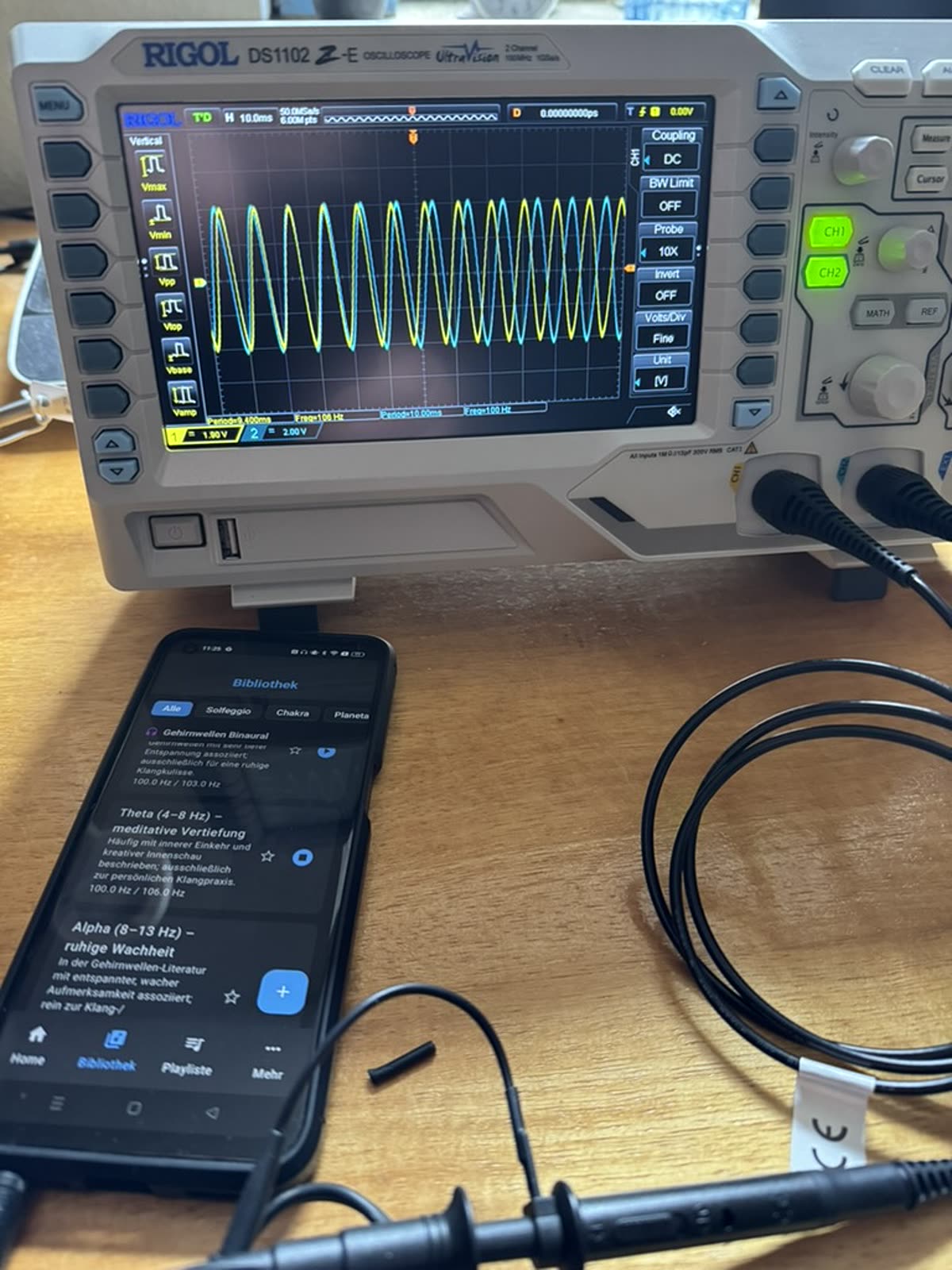
Two separate waveforms on screen: in yellow, the left channel at 100 Hz; in blue, the right at 106 Hz. Exactly what the preset in the app specifies. Both signals are clean, both are independent, no visible coupling between them.
The difference is 6 Hz — sitting cleanly in the theta range (4–8 Hz), as you'd expect for a meditative binaural preset. If you want the deeper context on how acoustic beats can influence brainwave activity, our article on the science of binaural beats covers it. The phone isn't just reproducing the right frequency. It's reproducing the right frequency pair, the kind that lets the brain generate the intended beat.
What the measurements show
- The app delivers what its display promises — frequency and waveform match
- A modern smartphone is entirely capable of clean frequency reproduction
- Binaural mode works technically as well — both channels remain independent
- There is no measurable technical reason to choose a €300 hardware device over an app
What the measurements don't show
The other side of the test matters just as much. I've shown that the signal is clean coming out of the phone — nothing more, nothing less. What these frequencies do to the body or mind is something an oscilloscope cannot measure.
The Solfeggio tradition, the association of certain Hz values with states like "letting go" or "realignment", the meditative effect of theta beats — these are things each person has to experience and interpret for themselves. We deliberately keep the descriptions in the app cautious ("associated with inner focus in some circles; no claims about relief or healing"). This test doesn't change that.
The technical context
Audio is one of the better-engineered subsystems in a modern smartphone. Even mid-range devices ship with 16-bit or 24-bit DACs and total harmonic distortion well below 0.01 %. In practice, audible quality is almost always limited by the headphones, not by the phone — and for the clean low-frequency sine waves measured here, even a basic pair of headphones is more than enough.
A dedicated hardware frequency device doesn't produce a "better" signal in the sense of being technically cleaner. What it offers is different — a different interaction model, perhaps different physical connections, sometimes just a nicer feeling at unboxing. But the claim that "only our device can do this cleanly" doesn't survive the first glance at an oscilloscope.
Measure for yourself
You don't need a €350 Rigol. Anyone curious about their own setup can pick up a USB oscilloscope adapter for under €50 today, or run a spectrum-analysis app on a second smartphone. The results will look similar. If you'd rather just hear it for yourself, the AuraHarmony demo on the homepage runs straight in the browser, no install needed.
Frequencies are physics. What you make of them is up to you.