Royal Raymond Rife and the CAFL List — A Beginner's Guide

 AI-gegenereerde afbeelding
You've probably run into Solfeggio frequencies, 432 Hz music, or binaural beats at some point. "Frequency wellness" is having a real moment right now — more and more people are using gentle tones and vibrations to unwind after a stressful day or go deeper in meditation.
Dig a little further into this world and one name keeps coming up: Royal Raymond Rife, along with something called the CAFL list. So who was this guy, what's actually behind his ideas, and how can you use this piece of history safely today?
Who was Royal Raymond Rife?
Here's the basic idea: everything around us — every object, every plant, our own bodies — is made of tiny particles in motion. Where there's motion, there's vibration. And where there's vibration, there's a tone or a frequency, even if we can't hear it with our own ears.
That idea captivated Royal Raymond Rife, an American inventor working in the 1920s and '30s. Rife made his name building unusually powerful microscopes, and his theory was as simple as it was bold:
- He believed every organism has its own characteristic vibration — what he called its "Mortal Oscillatory Rate," or MOR.
- The classic way to picture this: an opera singer hits the exact note that matches a wine glass's resonant frequency, and the glass starts to vibrate until it shatters.
- Rife wanted to track down frequencies like that in the lab and use them to influence living processes.
Here's the honest part: Rife's specific claims about what these frequencies could do were never scientifically confirmed. What survives is a genuinely interesting idea from the early days of vibration research — and the seed of what's now known as the CAFL list.
So what is the CAFL list, exactly?
Search for Rife frequencies today and you'll quickly run into the acronym CAFL — short for Consolidated Annotated Frequency List.
The easiest way to think of it: a historical reference book, or an alternative "dictionary of vibrations."
- It's not an official document. The CAFL isn't a scientific or medical chart. It came together on the internet in the late 1990s, when people interested in frequencies pooled Rife's old lab notes, ideas from other researchers (like Hulda Clark), and personal anecdotes into one running list.
- How it's structured. The list pairs specific terms, body areas, or states with a numeric value in Hertz (Hz) — one Hertz being one vibration per second.
How are Rife frequencies actually used today?
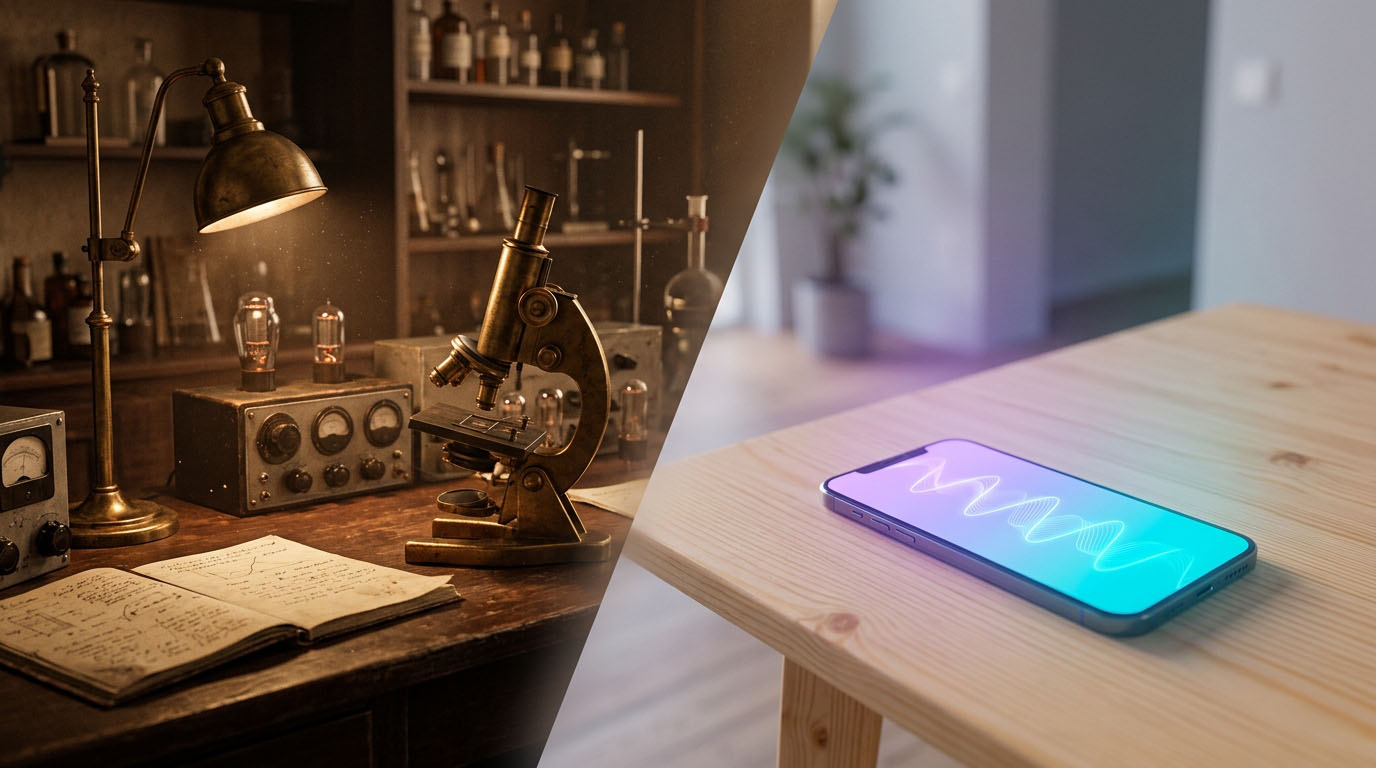
You don't need a lab full of equipment to experiment with vibration anymore. Modern tech puts frequency patterns right on your phone.
These days, using CAFL frequencies is almost never about medical treatment — it's about general relaxation and a sense of energetic balance. In wellness circles, people mostly reach for them for:
- Stress relief. Steady, gentle tones can give a restless mind something to hold onto — not unlike rain on a window or ocean waves.
- Meditation and focus. Many people run frequency tones in the background to settle into meditation more easily, or to concentrate while studying or working.
- A sense of energetic balance. In alternative frameworks, gentle vibration is thought to help get "stuck" energy moving again.
Your tool for trying this: the AuraHarmony app
You don't need expensive specialty hardware to explore this world hands-on. AuraHarmony lets you dial in, adjust, and test frequencies without any of the fuss.
- Build your own frequencies. Enter any value — including historical numbers from the CAFL list — and play it back as a clean tone. Experiment and see what actually feels good to you.
- Use it however fits your day. Daily meditation, falling asleep, or just a calming background tone while you work.
- Straightforward pricing. AuraHarmony is available on the Apple App Store and Google Play for a one-time $12.99 — no subscription, no hidden costs. Want to hear it first? The demo on our homepage runs right in your browser.
Before you start: safety first
If you're going to try frequencies on your own, a few basics are worth keeping in mind:
- This isn't a substitute for a doctor. Royal Raymond Rife's work and the CAFL list are fascinating historical and alternative frameworks — they are not scientifically recognized. Use frequencies for relaxation and general wellbeing only, never as a replacement for medical diagnosis or treatment.
- Start gentle. Try new frequencies for just 10–15 minutes at first, and pay attention to how your body and mind respond.
- Keep the volume low. These tones don't need to be loud to have a relaxing effect — a comfortable, quiet background level is ideal.
- Headphones help. Especially for anything in stereo format, a comfortable pair of headphones makes it much easier to fully tune in.
The takeaway
The world of frequencies offers a gentle way to carve out a little calm in a hectic day. Royal Raymond Rife's story is a reminder of just how long humans have been curious about the vibrations behind the natural world. The CAFL list, whatever you make of its scientific standing, is a fascinating archive — an invitation to explore the relationship between sound, body, and mind at your own pace. If this kind of history is your thing, our piece on medieval monk chants and Solfeggio frequencies is a good next stop.