Solfeggio Frequencies List — All 9 Frequencies from 174 to 963 Hz

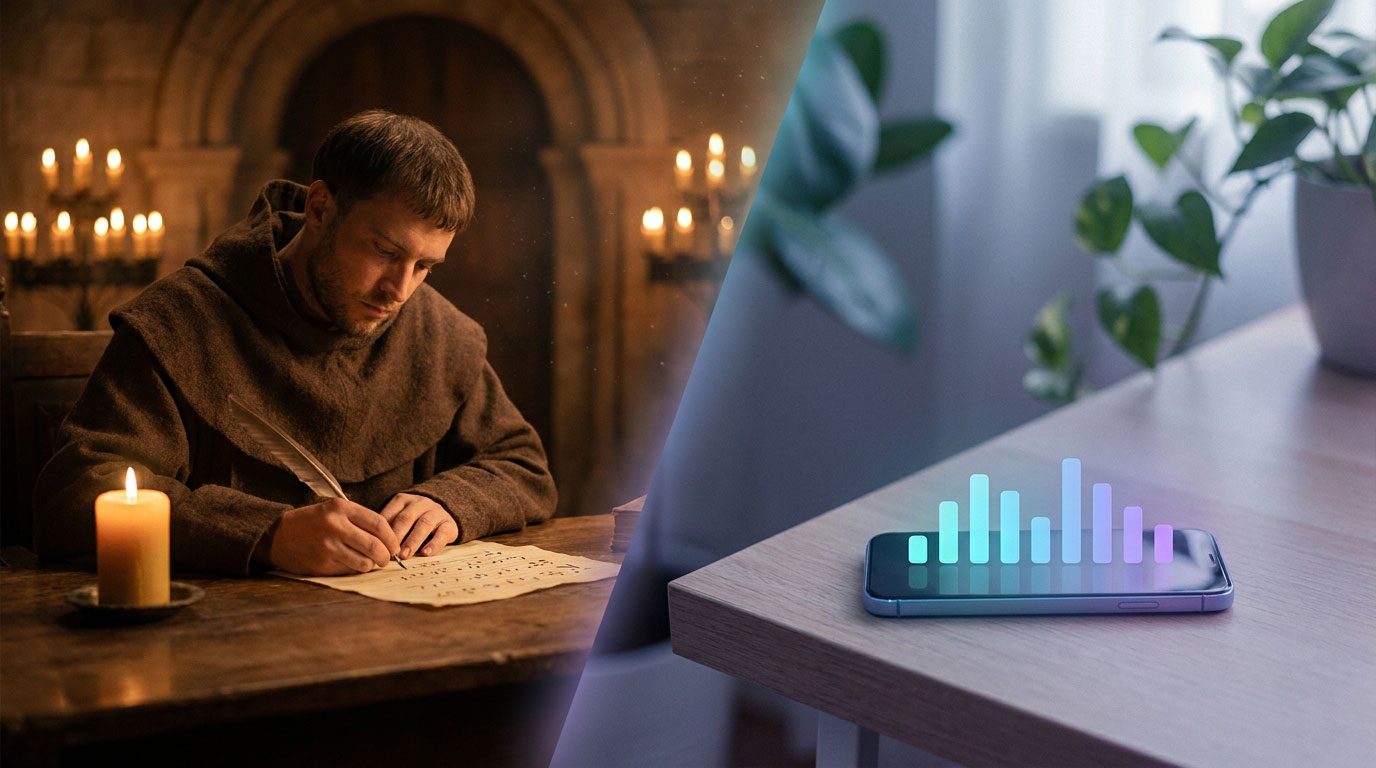 AI-gegenereerde afbeelding
Search for Solfeggio frequencies and you will mostly find two extremes: pages that attribute miraculous powers to every tone — and pages that dismiss the whole topic outright. This list takes a third path: for each of the nine frequencies it gives the traditional attribution (clearly labelled as tradition), followed by an honest assessment of what is supported by evidence and what is not.
One thing up front: many search results call Solfeggio tones "healing frequencies". We deliberately avoid that term — frequencies do not cure illnesses, and anyone promising otherwise is promising too much. What sound can do well: create a calm setting for relaxation, meditation and focus rituals.
The complete list of the 9 Solfeggio frequencies
| Frequency | Traditional attribution |
|---|---|
| 174 Hz | Safety and security, the "foundation" of the scale |
| 285 Hz | Regeneration and inner balance |
| 396 Hz | Releasing fear and guilt (Ut) |
| 417 Hz | Facilitating change, dissolving the old (Re) |
| 528 Hz | The "love frequency", transformation (Mi) — the best-known tone |
| 639 Hz | Connection and harmonious relationships (Fa) |
| 741 Hz | Expression and intuition (Sol) |
| 852 Hz | Clarity and spiritual order (La) |
| 963 Hz | Oneness, "return to source" |
The six middle tones (396–852 Hz) form the classic Solfeggio scale; 174, 285 and 963 Hz were added later, which is why most modern lists count nine frequencies.
Where the scale really comes from
The syllables Ut–Re–Mi–Fa–Sol–La go back to the Benedictine monk Guido of Arezzo (11th century) and the Hymn to St. John — a story we tell in detail in our article on medieval monastic chant. The specific Hertz values, however, are not medieval at all: they were derived in the 1990s by Dr. Joseph Puleo using numerology applied to the biblical Book of Numbers.
In other words: the mapping "396 Hz = releasing fear" is a modern tradition, not preserved knowledge of medieval monks and not a scientific finding. Knowing this, you can still enjoy and use the tones — just with realistic expectations.
What science says
Summarised honestly:
- Not supported: that individual Solfeggio frequencies have specific effects (DNA repair, chakra alignment, curing illnesses). There is no robust evidence for any of this.
- Plausible and partially studied: that calm, steady tones — including Solfeggio tones — can support relaxation responses. A few small studies report reduced stress markers after regular listening, but the evidence base is thin and effects vary between individuals.
- Well established (for a related topic): the basics of brainwave entrainment with binaural beats — a different concept that is often confused with Solfeggio. Our frequency comparison guide explains the differences.
In short: Solfeggio frequencies are a relaxation and meditation tool with a traditional background — no more, but also no less.
How to try the frequencies
- Pick one tone, not five. Start with 528 Hz (the most accessible) or 396 Hz (pleasantly deep).
- 15–20 minutes, quiet setting. Speakers are fine — unlike binaural beats, pure Solfeggio tones don't require headphones.
- Same time, same place, two weeks. Rituals work better than one-off sessions.
- Observe rather than expect. Which tone feels right is personal — there is no single "correct" frequency.
AuraHarmony includes all nine Solfeggio frequencies as precise sine tones — alongside binaural beats, planetary tones and a free frequency generator from 1 to 20,000 Hz. We even verified the app's output with an oscilloscope.
Frequently asked questions
Are Solfeggio frequencies the same as 432 Hz?
No. 432 Hz is an alternative concert pitch (a tuning standard for music), not a Solfeggio frequency. The nine Solfeggio tones are individual frequencies with their own tradition. We compare both concepts in the frequency guide.
Which Solfeggio frequency is "the best"?
There is no objectively best frequency. 528 Hz is the best known and the easiest entry point for most people. After that, your own perception decides.
Do I need headphones?
Not for pure Solfeggio tones — speakers work fine. You only need headphones for binaural beats, because each ear receives a different frequency.
Can Solfeggio frequencies cure illnesses?
No. There is no scientific evidence that Solfeggio frequencies cure or treat any condition. They are a wellness tool for relaxation and meditation. If you have health concerns, please consult a doctor.