Binaural Beats, Solfeggio, 432 Hz, and Rife Compared

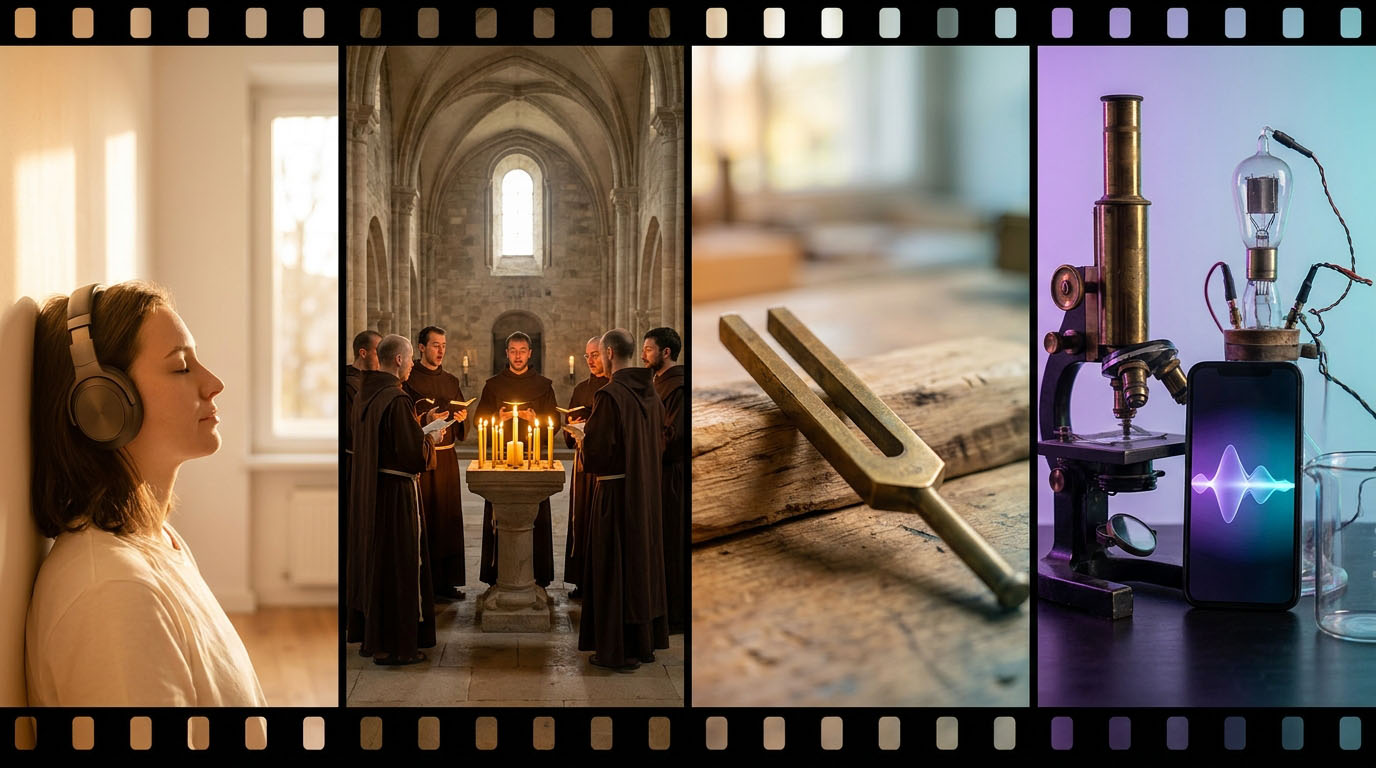 Imagem gerada por IA
Our days are loud, fast, and full of nonstop stimulation. No surprise, then, that more people are looking for ways to actually unwind at night or focus better while working from home. Alongside meditation and yoga, one acoustic trend has firmly taken hold over the past few years: listening to specific frequencies on purpose — a kind of symphony for the mind, tailored to your day.
Dig into the topic, though, and you'll run into a maze of terms: binaural beats, Solfeggio, 432 Hz, and Rife frequencies. What's actually behind each of these ideas? How do they affect how we feel, and which one fits which need? This guide sorts out the fascinating world of sound and mental wellbeing.
1. Binaural beats: a workout for your brain
Binaural beats are a genuinely interesting psychoacoustic phenomenon. They're not baked into an audio file — they happen inside your own brain.
For this to work, you need headphones. Your left and right ear each get a slightly different tone — say, 400 Hertz (Hz) on the left and 410 Hz on the right. Your brain tries to reconcile the difference and perceives a pulsing beat at the gap between them (in this case, 10 Hz).
This is known as brainwave entrainment. Your brain tends to sync up with the frequency it perceives:
- Alpha waves (8–12 Hz): A relaxed, alert state — good for creative work or winding down after a long day.
- Theta waves (4–8 Hz): Associated with deep meditation and the drowsy transition into sleep.
- Beta waves (12–30 Hz): Support logical thinking, concentration, and focus.
Binaural beats work well as a practical tool for nudging your mind toward whatever state you actually need — focus or relaxation.
2. Solfeggio frequencies: vibrations from an older tradition
While binaural beats are a modern, well-studied phenomenon, Solfeggio frequencies pull us deep into music history. According to the historical record, these tones trace back to medieval monk chants — like the Hymn to St. John the Baptist, credited to the Benedictine monk Guido of Arezzo, whose story we tell in more detail in our piece on medieval monk chants. In the 1970s, researcher Dr. Joseph Puleo went back to those old syllables and, using a numerology system, assigned each one a specific frequency in Hertz.
Here's the honest part: that mapping is a 20th-century invention, not something handed down from the monks themselves. If you want the more skeptical, better-sourced version of this story, our guide on understanding Solfeggio frequencies walks through it.
Solfeggio frequencies are still credited with a deep meditative effect. The best-known ones include:
- 396 Hz: Used in mindfulness practice to ease circling thoughts and gently release tension.
- 528 Hz: Often called the "transformation frequency" or the tone of inner peace — a favorite in meditation circles for general wellbeing and calm.
- 639 Hz: Said to support empathy and harmonious relationships.
In modern sound therapy and wellness practice, Solfeggio frequencies usually show up woven into ambient music or nature sounds, creating a calm backdrop for meditation.
3. 432 Hz tuning: in step with nature
Ever wonder why some music sounds warmer, rounder, and more pleasant than other recordings? The answer might come down to how the instruments were tuned.
Today's global standard tunes concert pitch A to 440 Hz. Advocates of 432 Hz tuning — sometimes called "Verdi tuning" — argue that this frequency resonates more harmoniously with the human body, claiming it lines up mathematically with patterns found in nature and the cosmos.
Acoustically, music tuned to 432 Hz often sounds a touch softer, with less edge in the highs. Many people find it noticeably more calming to listen to. It works well as background music for reading, unwinding, or a yoga session.
4. Rife frequencies: a historical look at an alternative approach
Rife frequencies come from a very different angle, tracing back to American inventor Royal Raymond Rife in the 1930s. Rife built unusually powerful microscopes and proposed that all matter — including biological structures — has its own characteristic frequency, or resonant rate. We cover the fuller history in our guide to Royal Raymond Rife and the CAFL list.
In today's frequency community and alternative wellness circles, Rife frequencies (often catalogued in lists like the CAFL) are treated as tools for energetic balance and supporting the body's own regulatory processes.
A note on where this actually stands: Rife frequencies are not scientifically recognized and are not a substitute for medical diagnosis or treatment. In wellness practice, they're used purely as a complementary tool — a way to explore energetic balance and body awareness, nothing more.
From theory to practice: your own frequency space
If you want to work frequencies into your daily life, mainstream streaming platforms tend to get in the way — ad breaks interrupt the calm you just built, pre-made tracks can't be adjusted to what you actually need, and most of these services require a constant internet connection.
To make this smoother and more personal, we built AuraHarmony — your private, fully flexible frequency generator, right on your phone (iOS and Android).
- Everything in one app. AuraHarmony brings together binaural beats, Solfeggio frequencies, planetary tones, and chakra frequencies in one place.
- Full creative control. Dial in your own frequencies exactly, combine them freely, and build personal playlists for your day — great for things like custom Rife combinations or tailor-made brainwave sessions.
- Built to stay out of your way. The app runs entirely on your device. That means no data tracking, no internet requirement during meditation, and no distractions.
- A fair deal. Instead of a pricey subscription, AuraHarmony is transparent: a one-time $12.99, no hidden costs. Want to hear it first? The demo on our homepage runs right in your browser.
Which frequency fits you? A quick checklist
Use this short checklist to figure out where to start today:
- Want to focus deeply, study, or get into a productive flow? Binaural beats in the beta range (roughly 12–20 Hz) are your pick — headphones work best here.
- Looking for a deep, meditative reset to fully switch off? Solfeggio frequencies like 528 Hz or 396 Hz are well suited to mindfulness practice.
- Just want gentle background music for reading or yoga? Music or nature sounds tuned to 432 Hz fit the bill.
- Want to support your sense of energetic balance and experiment with subtler vibration patterns? Chakra, planetary, or historical Rife frequencies are your starting point.
The takeaway: the power of listening on purpose
Whether it's well-studied psychoacoustics or centuries-old tradition, frequencies are a simple, natural tool for shaping your mental state. None of this takes real effort — just a bit of time, a willingness to listen, and some attention to how your own mind responds to the sound.
Try a few different approaches and build your own personal, acoustic corner of calm, one session at a time.